Cycling in the Sierra de Aracena: Best Routes, Events & Practical Tips
Cycling in the Sierra de Aracena: Best Routes, Events & Practical Tips
A practical guide to cycling in the Sierra de Aracena: explore the Sierra de Aracena by bicycle with our 2026 HUEX Gran Fondo recap, three road-route ideas and honest advice on climbing, summer heat, navigation, water stops and making time for lunch along the way.
September 2026 put the Sierra de Aracena firmly in the cycling spotlight. On September 8th, Stage 16 of La Vuelta a España started in Cortegana and carried the professional peloton through Almonaster la Real, Castaño del Robledo, Fuenteheridos and Aracena. Eleven days later, the same roads filled with bicycles again, as more than 550 riders gathered in Aracena for the first road edition of the HUEX Gran Fondo.
One was an elite international race broadcast around the world. The other was a mass-participation ride for cyclists who wanted to experience the Sierra for themselves. Together, they made a convincing case for this corner of Andalucía as cycling country. This guide explains why riders keep coming here, and how you can plan a ride of your own.
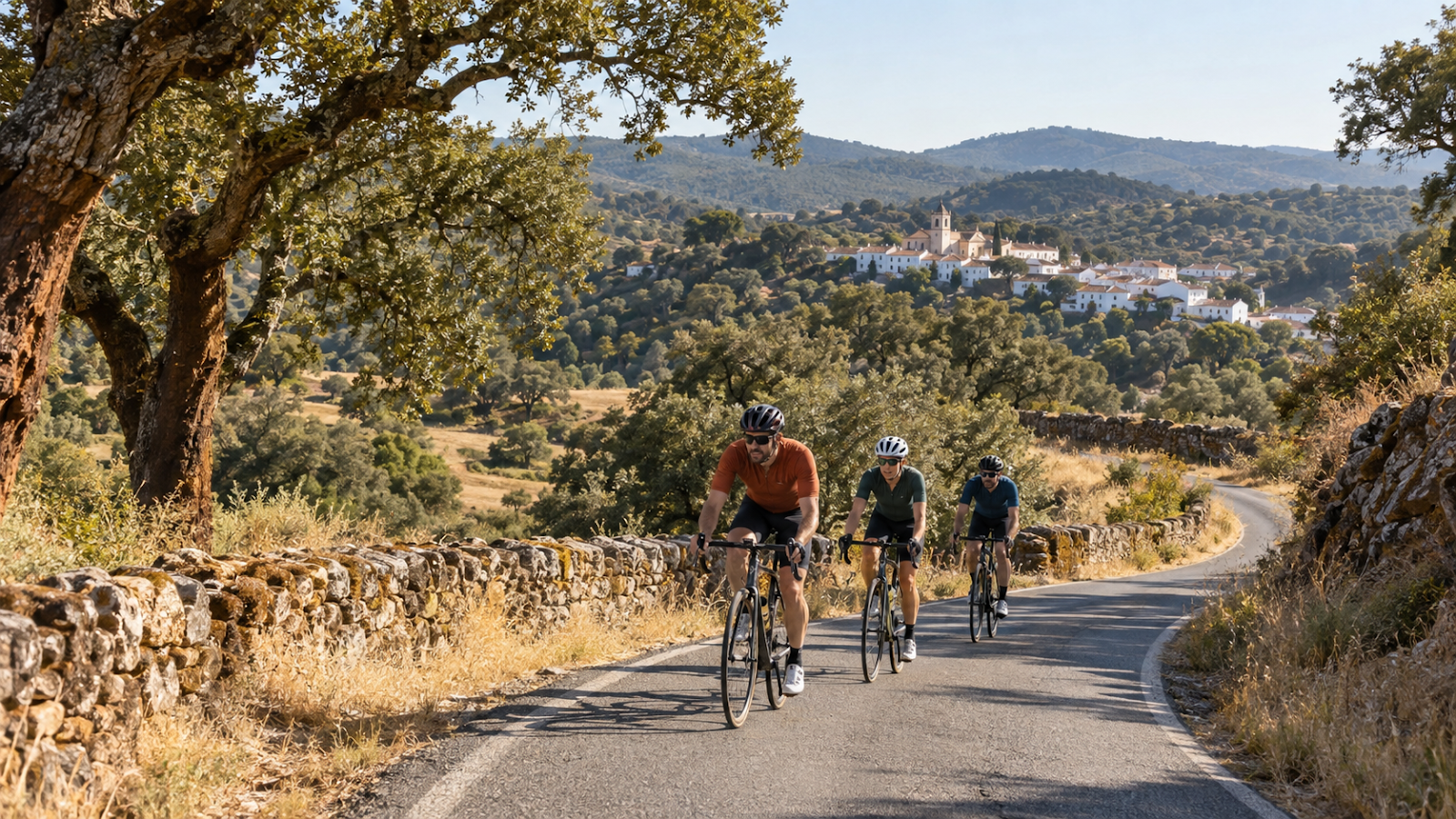
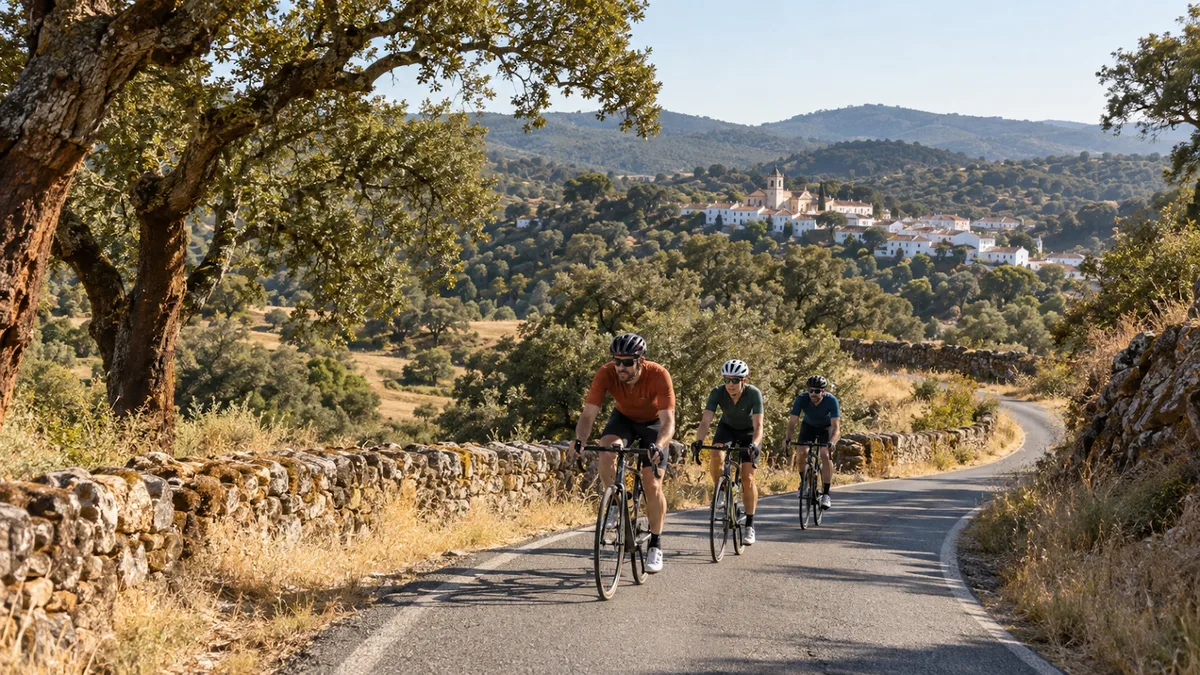
Stone walls, oak woodland and another climb ahead: cycling through the Sierra de Aracena. (AI-generated image)
Cycling at a Glance
Best for: Road cycling, hill training and longer loops broken up by village stops
Terrain: Paved climbs and descents, with gravel roads and forest tracks available on some routes
What to expect: Repeated climbs, sharp bends, stretches beneath holm and cork oaks, and plenty of villages where coffee or lunch can become part of the ride
Best seasons: Spring and autumn; during summer, leave early and avoid riding through the hottest part of the afternoon
Navigation: Signposting is inconsistent, so download the route and an offline map before setting out
Check before riding: Weather, recent storm damage, temporary trail restrictions and whether public fountains are running
La Vuelta Comes to the Sierra
La Vuelta a España is one of professional road cycling’s three Grand Tours, alongside the Giro d’Italia and the Tour de France. Each year, the world’s leading teams race across Spain for three weeks, and every stage is broadcast to audiences around the world.
Stage 16 of the 2026 edition, on Tuesday, September 8th, was a hilly 181.1-kilometre stage from Cortegana to La Rábida in Palos de la Frontera. Before heading south towards the coast, the peloton crossed the heart of the Sierra through Almonaster la Real, Castaño del Robledo, Fuenteheridos and Aracena, then continued towards Campofrío and Riotinto. James Matthew Brennan of Visma | Lease a Bike won the stage at La Rábida.
For visitors, that matters. The roads you can ride from Aracena are the same ones chosen for one of the sport’s biggest races, and the television coverage showed a side of Huelva many viewers had never pictured: chestnut woods, white villages and one climb after another. You can ride them at your own pace, with a coffee stop along the way.
Eleven Days Later: The 2026 HUEX Gran Fondo
Eleven days after the professionals crossed these roads, it was the amateurs’ turn. The name HUEX grew out of Huelva’s extreme-distance cycling calendar, and the Gran Fondo course lived up to it: approximately 148 kilometres with 2,825 metres of climbing, beginning and ending at the Aracena fairground. The circular route crossed a large part of the Sierra, including Linares de la Sierra, Alájar, Santa Ana la Real, Almonaster la Real, Cortegana, Encinasola and Cañaveral de León, before returning to Aracena. Anyone who knows these roads will understand what those figures involve.
On September 19th at eight o’clock in the morning, more than 550 cyclists left the Aracena fairground together. It was the first road edition of the HUEX Gran Fondo, and riders had been given eight hours to complete the course.
For approximately the first 47 kilometres, the group travelled under controlled speed behind the Guardia Civil and the organisation vehicles. Nobody was permitted to ride off the front. That changed after the first refreshment stop near Aroche, where cyclists were released to continue at their own pace, with more than 100 kilometres and a considerable amount of climbing still ahead.
The route then continued through the western Sierra, with further food and control points in Encinasola and Cañaveral de León. Riders eventually returned to the same fairground in Aracena, where families, cycling teams, volunteers, and spectators had been gathering since early morning. Local coverage described the venue remaining busy throughout the day, rather than emptying once the bicycles had disappeared into the hills.
HUEX officially classifies the Gran Fondo as a non-competitive marcha cicloturista: a mass-participation cycling event intended for riders to complete rather than a conventional road race with teams competing for a title. Times were still recorded, however, and the first arrivals received special recognition. Javier Ramírez Abeja and Ugne Dubauskaite were the first man and woman to finish. You can search the complete 2026 classifications and arrival times on Sportmaniacs.
The turnout also explains why the event mattered to Aracena. More than 60 percent of the registered cyclists came from outside Huelva province, bringing support crews, relatives, and weekend visitors into the Sierra. The car parks offered the first clue that this was not an ordinary September weekend: bicycles were fastened to roofs, and cycling jerseys were everywhere.
If you would like to see the preparations around town, TV Aracena filmed a local preview of the 2026 event. The official HUEX route page also includes the course profile and downloadable track.
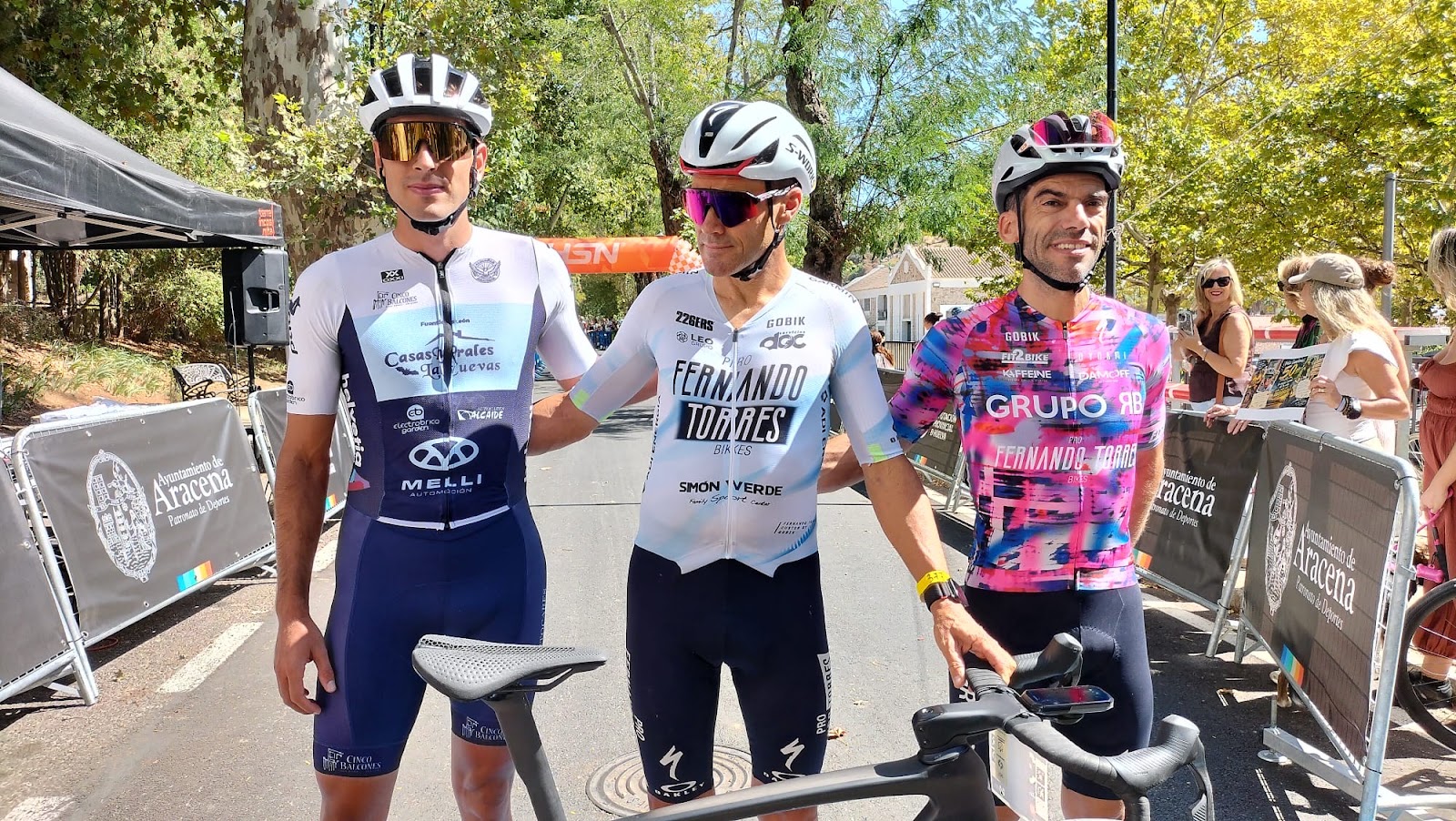
Bikes down and spirits high after a day on the Sierra's roads at the HUEX Gran Fondo. Photo: Ayuntamiento de Aracena
Why Cyclists Keep Coming to the Sierra de Aracena
What Makes the Sierra Good Cycling Country?
The climbing accumulates: Roads rise and fall repeatedly between villages, allowing cyclists to build considerable elevation without relying on one famous mountain pass.
The villages: Aracena, Alájar, Linares de la Sierra, Fuenteheridos and the smaller communities around them create natural places to refill water, eat or shorten a route.
Several types of riding are possible: Paved roads serve road cyclists, while rural lanes, old mule paths and forest tracks open up options for gravel and mountain bikes.
The landscape changes with the season: Chestnut woods, cork and holm oak pasture, river valleys and the more open western Sierra can all appear within the same long ride.
Plan for a succession of climbs rather than one headline ascent. Flat recovery sections are often brief, and later in the ride it is the accumulated elevation you will feel most clearly in your legs. Ease off before blind bends; a tractor, a flock of sheep, or someone on horseback could be occupying the road around the corner.
Village spacing is one of the Sierra’s greatest advantages. A cycling loop can pass through several places without forcing you back onto the same road, and each stop has its own character. You might refill your bottles in Linares de la Sierra, find a nice cafe near the centre of Alájar or arrange lunch back in Aracena. Check opening hours before relying on a particular bar or shop, especially during the afternoon and in smaller villages. Public fountains should never be your only water plan.
Off the asphalt, the Sierra has another network altogether. Historic mule paths, farm roads, and forestry tracks cross the same country used for walking, livestock, and agricultural work. The GR-48 bikepacking route runs for hundreds of kilometres across Sierra Morena, much of it through the natural parks of Aracena and the Sierra Norte de Sevilla. It gives experienced riders an idea of the scale available here, though it should not be treated as permission to ride every track shown on a map. Some paths cross private fincas where gates must be closed behind you, and rain can alter an unpaved section considerably.
The amount of green often catches first-time riders by surprise. Andalucía may bring dry plains and sun-bleached hills to mind, but much of the Sierra’s landscape takes on a more varied palette. Holm and cork oaks spread across the dehesa, chestnut groves cluster around Fuenteheridos, Galaroza and Castaño del Robledo, and the ground becomes cooler and more densely planted near streams. Depending on the route and season, you may pass ferns, poplars, willows, and banks of wildflowers within the same morning.
This variety changes the atmosphere for riders. You may cross an open pasture with Iberian pigs beneath the oaks, and then disappear among chestnut trees or follow water through a greener valley. Spring brings the brightest colour, and autumn turns the chestnut woods copper and gold. By late summer, the grass has dried and water becomes harder to find. Tree cover helps, but it is scattered rather than continuous, so we would still avoid a long ride during the hottest days and hours.
Cycling in the Sierra did not begin with HUEX. Aracena’s local cycling clubs have organised weekend rides and routes through the Sierra for years. The Ruta Cicloturista BTT del Jamón, for example, has connected Aracena with Los Marines, Fuenteheridos and Galaroza. Its name says something rather lovely about local priorities: even a mountain-bike event can somehow be associated with the region’s beloved jamón.
If cycling will be one part of a longer stay, begin with our ultimate guide to Aracena and seasonal guide. Our guides to reaching Aracena and visiting without a car are also useful when deciding how you, and your bicycle, will get here.
Three Road Cycling Ideas from Aracena
The routes below give you three very different days on the bicycle. The first leaves plenty of time for coffee and an afternoon in Aracena. The second occupies most of the day. The third follows the HUEX Gran Fondo course and belongs firmly in experienced hands.
Distances and elevation can change when you alter a village stop or take a different road at a junction. Download the GPX, inspect the route in your preferred cycling app, and check for recent road closures before leaving. Only the HUEX course is an official event route.
Route 1: Aracena, Linares de la Sierra and Alájar
Distance: Approximately 30 kilometres before optional detours
Elevation: Plan for roughly 500–700 metres
Surface: Paved roads
Difficulty: Moderate
Allow: Two to four hours, including a village stop
Best for: A first ride in the Sierra or a shorter day between longer routes
From Aracena, the road descends towards Linares de la Sierra, then continues towards Alájar before circling back. The relatively short distance should not be mistaken for flat riding. You lose height on the way out of Aracena, but must tackle it on the return up.
Both villages can inspire you to get off your bike for their own unique qualities. Linares has its stone-paved streets and small central plaza, while Alájar offers cafés and restaurants beneath the Peña de Arias Montano. If your legs are still agreeable, you can add the climb to the Peña. It adds elevation quickly, so make that decision before ordering lunch rather than attempting it on a full stomach afterwards.
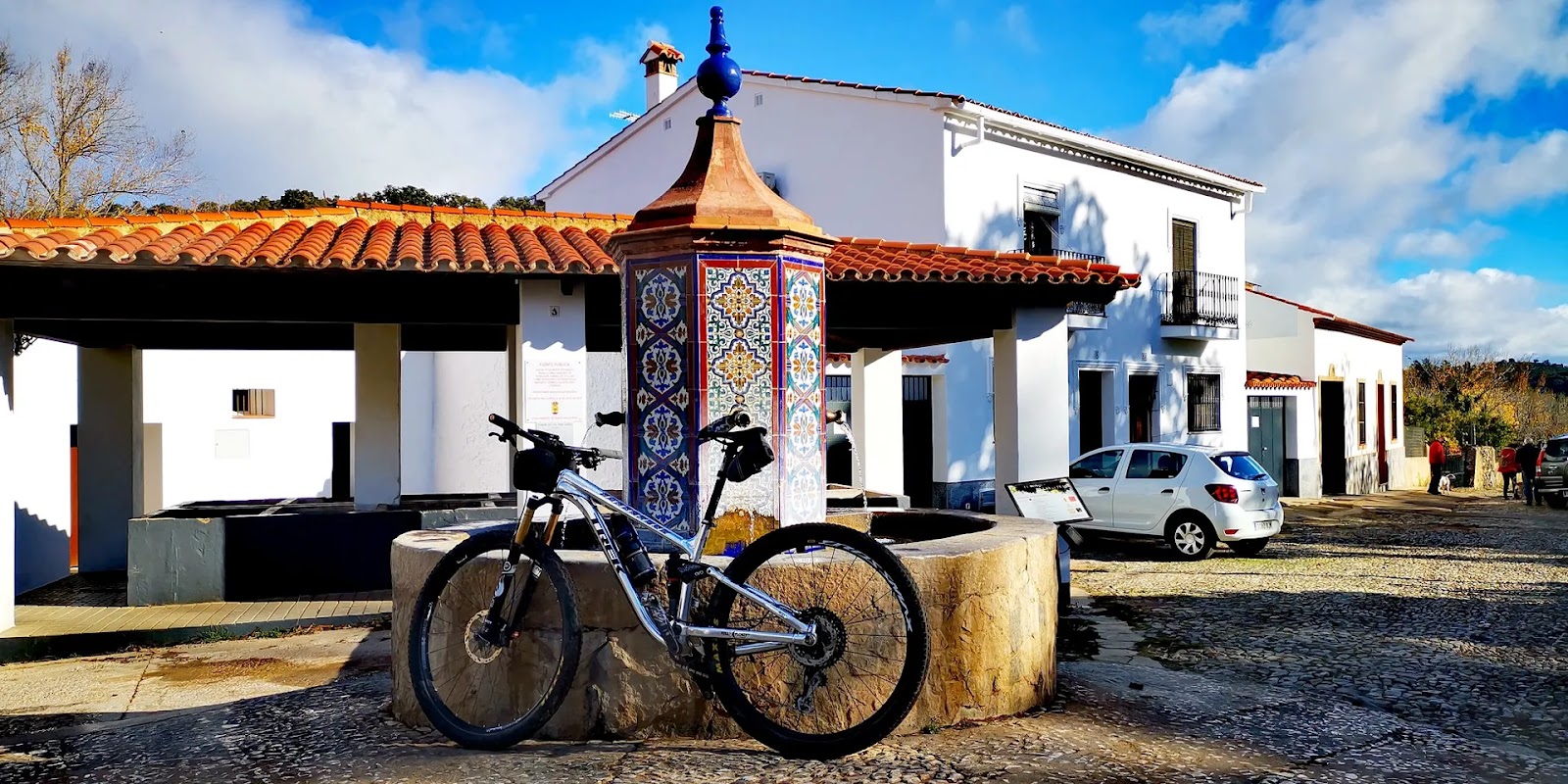
A village fountain makes an inviting place to pause, although you should always confirm that the water is potable before refilling your bottles. Photo: Komoot
Route 2: The Western Village Circuit
Distance: Approximately 70 kilometres
Elevation: Approximately 1,250 metres
Surface: Predominantly paved roads
Difficulty: Challenging
Allow: Four to six hours, depending on stops
Best for: Experienced road cyclists wanting a full tour of the central Sierra
This longer circuit links Aracena with Los Marines, Castaño del Robledo, Santa Ana la Real, and Linares de la Sierra. The published Komoot route provides a useful starting point, although you should inspect its current surface information and adjust the course to suit your bicycle.
The surroundings change repeatedly along this circuit, which is visually stimulating for riders. Chestnut groves surround Castaño del Robledo, followed by smaller roads near Santa Ana la Real. Stone walls and oak pasture return as you approach Linares. Experienced cyclists may be accustomed to covering 70 kilometres, but it’s still good to note the 1,250 metres of accumulated climbing; this may change how those kilometres feel.
Choose your lunch stop before setting out and confirm that somewhere will be open. It’s one of those “better safe than sorry” scenarios for your meal planning; we have learned not to build a Sierra itinerary around opening hours found on an old listing.
Route 3: The HUEX Gran Fondo Course
Distance: 147.4 kilometres
Elevation: Approximately 2,825 metres
Surface: Paved roads
Difficulty: Very challenging
Time limit during the event: Eight hours
Best for: Highly experienced cyclists accustomed to long rides, repeated climbing and independent nutrition planning
The official HUEX course begins and ends at the Aracena fairground. It reaches deep into the western Sierra, passing communities including Almonaster la Real, Cortegana, Encinasola, the three Cumbres, Hinojales and Cañaveral de León before returning to Aracena.
Riding the course outside the organised event is a different undertaking. You will not have closed roads, event signage, medical support, or stocked refreshment points waiting along the way. Divide the route into sections, identify several places where you can obtain food and water, and carry enough to continue if one of them is closed. Start with working lights, a charged phone, repair equipment, and a safe exit plan if weather, fatigue or a mechanical problem changes the day.
Do not schedule much for the evening. A shower and a substantial meal are enough of an itinerary; our Aracena restaurant guide can handle the second part.
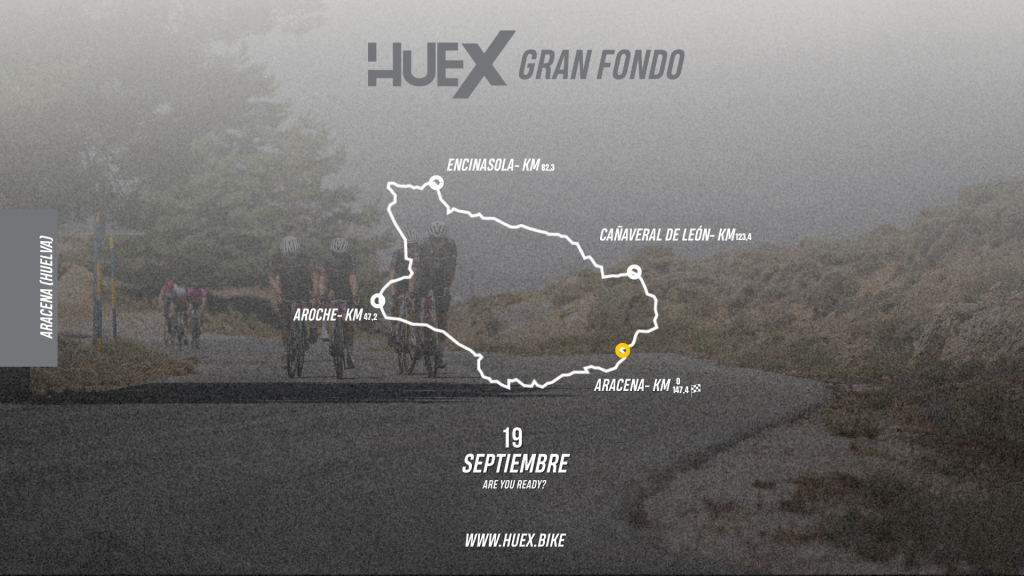
The 2026 HUEX Gran Fondo covered 147.4 kilometres and approximately 2,825 metres of climbing before returning to Aracena.
Other Cycling Events to Watch
The HUEX Gran Fondo is the road event in a much wider provincial calendar. HUEX also runs mountain-bike and gravel events, each using a different part of Huelva and requiring a very different kind of preparation.
HUEX MTB
The 2026 HUEX MTB took place on March 14th and finished in Cortegana. Riders could enter the 159.8-kilometre Extrema from Villablanca or the shorter 82.5-kilometre Maratón from Villanueva de las Cruces. Both crossed tracks and historic paths on their way north towards the Sierra.
This is one event where downloading the race track does not give you a route to repeat later. Parts of the official course pass through private fincas under permission granted specifically for race day. HUEX publishes separate training tracks so cyclists can prepare without entering closed land. Use those alternatives and leave the event course alone outside the authorised date.
Ruta Cicloturista BTT del Jamón
Aracena also has a cycling event with a name that could only belong to this part of Spain. The Ruta Cicloturista BTT del Jamón has previously linked Aracena with Los Marines, Fuenteheridos and Galaroza using countryside tracks through the central Sierra.
The route belongs to the area’s older mountain-biking tradition and is associated with local cycling clubs. Its schedule and course have changed between editions, so look for a current announcement before building a trip around it. An old GPX is useful for research, not proof that every gate and path remains available.
HUEX Gravel
The HUEX calendar finishes on the coast at El Rompido, although its longest route reaches across much more of the province. From November 13th–15th, the 2026 HUEX Gravel Ride asks participants to cover more than 500 kilometres in a self-supported format. Riders decide when to eat, rest, and sleep, then complete the course within 55 hours.
The HUEX Gravel Race takes place on November 14th. Its 132.7-kilometre course is the competitive option, with approximately 60 percent of the route away from asphalt. Both begin and end in El Rompido, making them useful additions to a longer Huelva trip rather than events based solely in the Sierra.
Cycling dates do not remain fixed from year to year, and routes may change with weather, land access or road conditions. Check the official HUEX website and our Explore Aracena events calendar before reserving accommodation or transporting a bicycle across Spain.
Bike Hire, Guided Rides and Local Support
You do not necessarily need to transport a bicycle to Aracena. eBike Aracena rents electric mountain bikes and arranges personalised routes through the Sierra. Its maintenance page currently lists telephone and email contacts for reservations. Contact the company before travelling to confirm bike sizes, collection arrangements, battery range, and what equipment is included.
For a longer cycling holiday, Finca El Moro runs guided eMTB stays from a restored finca near Fuenteheridos. These are small-group, multi-day experiences with accommodation and guided riding included, rather than bicycles collected for an independent afternoon.
At the time of writing, we could not confirm a road-bike rental fleet operating from central Aracena. If you want a specific road or gravel setup, bringing your own bicycle remains the safest plan. Ask any rental provider directly before assuming it has your frame size, preferred pedals, or the correct bicycle for an event.
Rental assistance also has its limits once you are out in the Sierra. Carry a tube even when riding tubeless, along with tyre plugs, a pump, quick link and multi-tool. Save the provider’s number in your phone and ask what happens if a mechanical problem leaves you unable to return the bicycle.
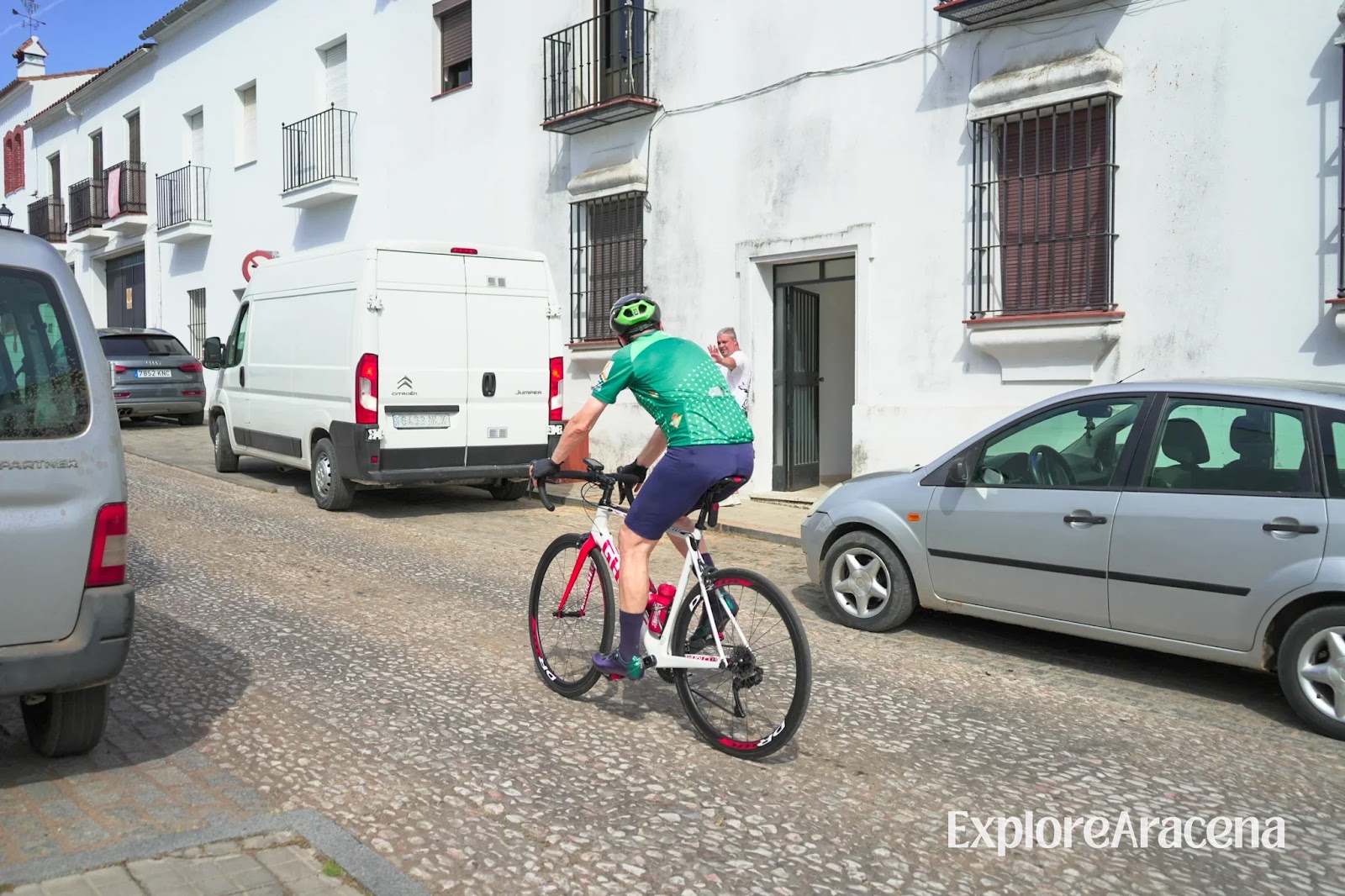
A wave from the roadside: even the briefest journey through a town comes with signs of local life.
Choosing the Right Season
Spring
March through May offers green pasture, running streams, and longer hours of daylight. Wildflowers begin appearing beside the roads, and the chestnut woods fill out as the season progresses. Rain can leave forestry tracks soft or deeply rutted, so inspect off-road routes before committing to them.
Summer
June, July and August require a different schedule. Leave at first light, carry more water than you expect to drink and finish before the strongest afternoon heat. Tree cover varies considerably from one road to the next; a shaded opening hour does not tell you what conditions will be like later in the route.
Check the hourly forecast, not simply the daily maximum. Postpone the ride during extreme-heat or wildfire warnings. No planned distance is important enough to argue with an Andalusian heat alert.
Autumn
September can still feel thoroughly summery during the afternoon. Temperatures usually become more accommodating as autumn progresses, bringing some of the year’s loveliest cycling weather. Chestnut leaves begin changing colour, and the first rain restores green to the pasture.
Those same rains can wash loose material onto roads and alter unpaved tracks. Chestnut harvesting, mushroom foraging, and agricultural work also bring more people and vehicles into the countryside. Our guides to September in Aracena and October mushroom season explain what else may be happening during your visit.
Winter
Clear winter days can be excellent for cycling. Mornings may begin cold and damp, particularly in valleys and wooded areas, and daylight disappears earlier than many visitors expect in southern Spain. Pack a layer for descents, watch for wet leaves and begin with enough time to finish before dusk.
For a wider view of the year, see our guide to the best time to visit Aracena.
Navigation, Road Rules and Rural Etiquette
Download the GPX and an offline map. Mobile coverage can disappear in valleys. Check the route at junctions instead of trusting an app to correct a wrong turn several kilometres later.
Tell someone where you are going. Share the route and expected return time. Carry a charged phone and save 112, the emergency number used throughout Spain and the European Union.
Make yourself visible. Spain’s DGT cycling guidance requires a helmet on interurban roads. Lights and reflective clothing are required at night or in poor visibility. We would carry front and rear lights even when planning to return in daylight.
Inspect your brakes before the trip. The Sierra’s descents can be long enough to expose worn pads or poorly adjusted brakes. Carry the tools and parts needed for the punctures and minor mechanical problems you know how to repair.
Treat every bend as occupied. A tractor, livestock, a horse, or another vehicle may be out of sight around the corner. Control your speed and leave room to react.
Respect gates and private land. A line on a navigation app is not proof of public access. Do not pass propiedad privada signs or locked gates. Close any livestock gate you are permitted to cross and remain on the established route.
Carry a complete food and water plan. Village shops and bars may close in the afternoon or on particular weekdays. Public fountains can run dry. Bring enough to reach a second resupply point if the first one fails.
Building the Ride into Your Stay
For the shorter Linares and Alájar circuit, begin after breakfast and let the village stop become the heart of the ride. Lock the bicycles, order coffee, and wander around instead of treating the plaza as a refuelling station with prettier chairs. Lunch can follow in the village or back in Aracena; reserve ahead if you have chosen a particular restaurant.
Keep the afternoon flexible. After a short route, you may still feel like following our walk from the market to Aracena Castle. Although, after 70 kilometres and 1,250 metres of climbing, you may feel like following the shortest available route to a shower. Both are respectable decisions.
A visit to the Gruta de las Maravillas requires a timed ticket, so schedule it on a separate day or after a route you know you can finish comfortably. Long rides are poor companions for inflexible reservations.
An overnight stay gives you more room. Ride on the first day, then use the second for the cave, a village visit, or one of the routes in our Sierra de Aracena hiking guide. Our restaurant guide can handle the evening meal, and the Marimateos picnic area offers an easier outdoor plan for tired legs the following day.
A bicycle changes your sense of distance in the Sierra. Villages that looked far apart become part of one continuous landscape, joined by the climbs, bends, and roadside stops between them. You will return to Aracena with tired legs and a new map of the Sierra in your head, full of village stop charms and hidden treasures discovered along the route.
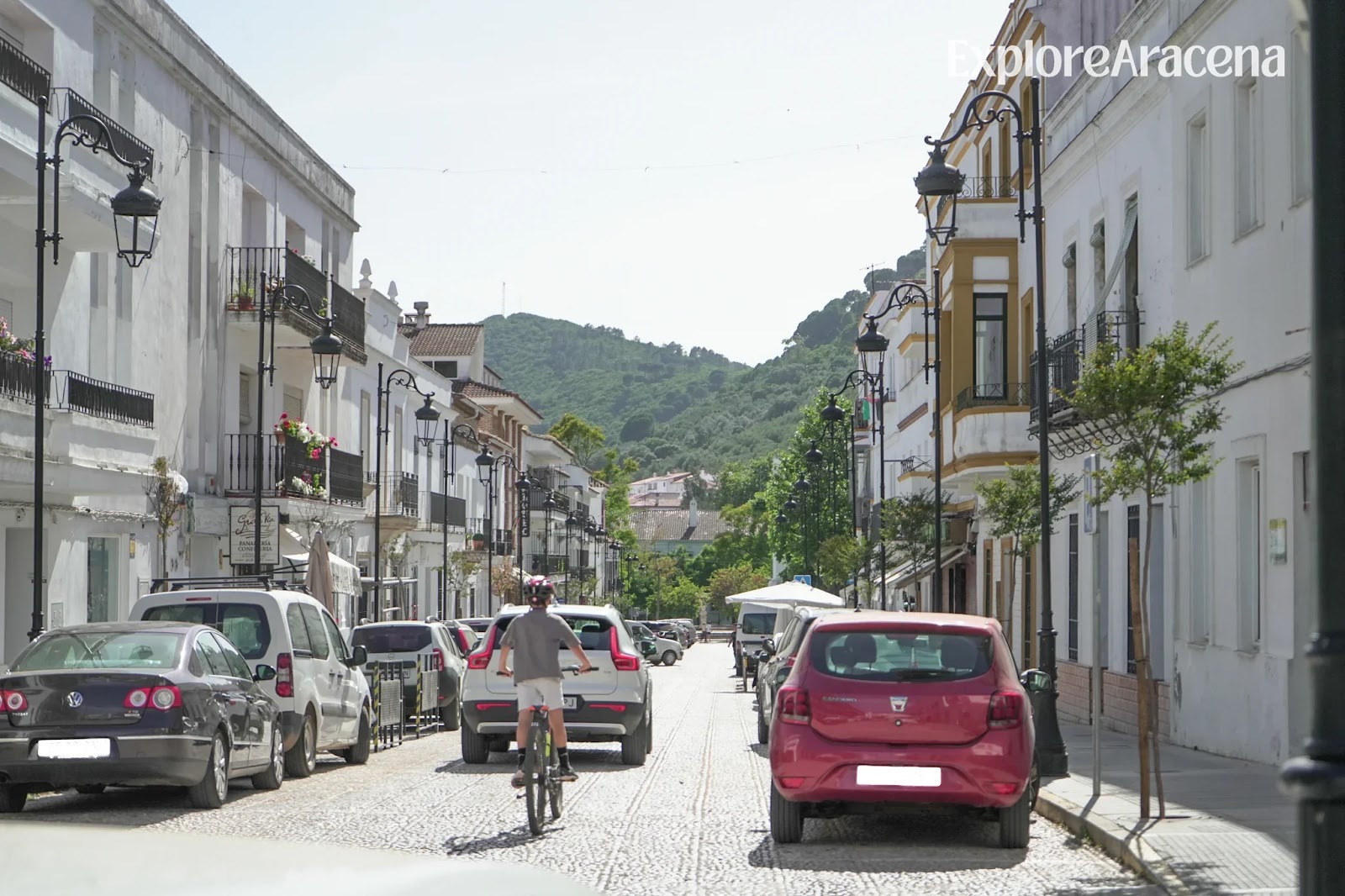
The road carries cyclists from everyday streets back towards the green hills surrounding the town.
Before You Ride
GPX downloaded and offline map tested
Weather, wind and official warnings checked
Helmet, front light and rear light packed
Water capacity matched to the route and temperature
Enough food carried if the planned stop is closed
Tube, plugs, pump, multi-tool and quick link packed
Brake pads and tyre condition checked
Phone charged and emergency contact given the route
Cash or card carried for unplanned stops
Event details or land-access restrictions reconfirmed