Las Tinajas in Aracena: Two Lunches and a Guide to the Menú del Día
Las Tinajas in Aracena: Two Lunches and a Guide to the Menú del Día
We visited Restaurante Las Tinajas twice: first for a €13 menú del día beside the Museo del Jamón, then for a generous shared lunch during the Feria del Jamón. Here is what the two meals reveal about the restaurant, Spanish lunch culture and eating well in Aracena.
Las Tinajas has now been part of two very different afternoons for us in Aracena.
On our first visit, the town was moving at its usual pace and we were actively searching for a menú del día. At Las Tinajas we found just that, with two courses, a drink, and dessert included. The service was seamless and the food kept arriving until lunch had become far more generous than its price suggested. If the words menú del día mean little to you now, they will make considerably more sense by the end of this article.
We returned during the final weekend of the 2026 Feria Regional del Jamón y del Cerdo Ibérico. Aracena was full of visitors and restaurant tables were in serious demand. This time, we ordered from the à la carte menu and settled in for a larger meal, knowing that the feria crowd would give the afternoon a much slower pace.
These two lunches introduced us to Las Tinajas under completely different circumstances. They also gave us two versions of Spain’s lunch culture to explore.
In this review, we will take you through both experiences and explain what makes the menú del día such a beloved part of eating in Spain. Lunch here can take many forms, but what remains consistent is how it’s more than just a meal; it’s an experience.
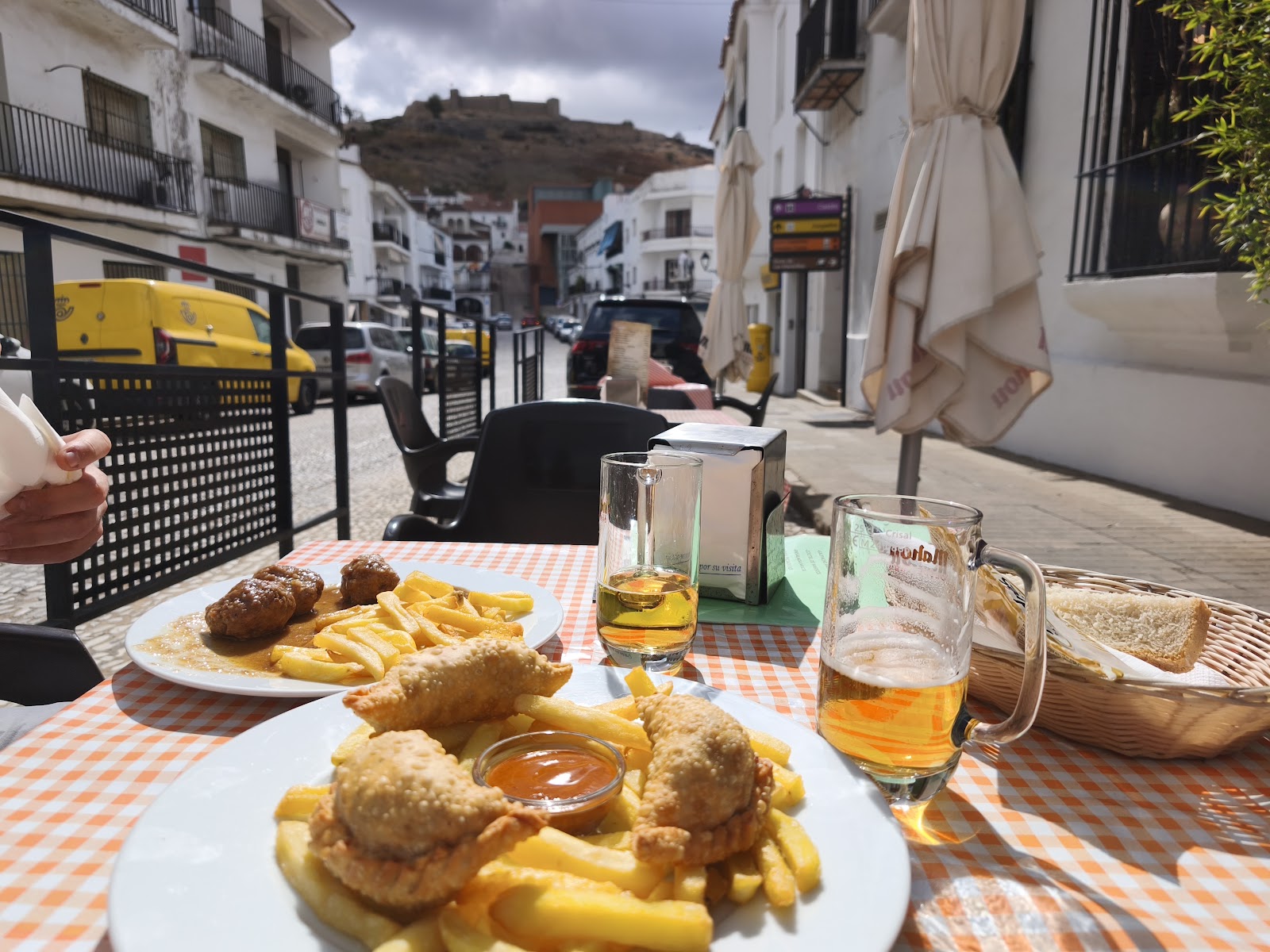
Our first lunch at Las Tinajas came with generous plates, cold beers and a clear view of Aracena Castle from the street terrace.
Las Tinajas at a Glance
Where: Beside the Museo del Jamón, close to the Gruta de las Maravillas and the paths towards the castle hill
Cooking: Spanish and regional dishes, with a mixture of set-menu choices and food ordered separately
What we paid: €13 per person for the menú del día on our first visit; €75 for five people ordering from the à la carte menu
Best for: A substantial lunch during a day in central Aracena
Reservations: Strongly recommended for weekends, holidays and major events
Telephone: +34 959 12 61 06
Beside the Museo del Jamón, Beneath the Castle
Las Tinajas sits on Calle Juan del Cid López, immediately beside the Museo del Jamón. The official Aracena tourism directory describes it as a restaurant serving Spanish cooking and notes its success in local tapas competitions.
The location alone makes it fit easily into a day spent exploring central Aracena. The Museo del Jamón is next door, and the entrance to the Gruta de las Maravillas is only a short walk away.
Aracena Castle rises above this part of town. From our table, we could see the fortified enclosure on the hill, bringing one of the town’s most recognisable views directly into lunch.
The restaurant also has an interior terrace, where you can enjoy the open air without sitting beside the street. On a beautiful day, it offers a particularly pleasant setting for a long meal, which is where we sat on our second visit.
Inside, the dining room has a traditional character, with tiled details and the settled appearance of a restaurant that has served many lunches. It does not feel arranged around a particular design trend. People come here to eat, and the portions suggest the kitchen understands that assignment very well.
The restaurant forms part of the same building complex as the Museo del Jamón, although the museum identifies the restaurant as privately managed. They are convenient neighbours rather than a single visitor attraction. You can visit one without committing to the other, but together they make a particularly fitting Aracena afternoon.
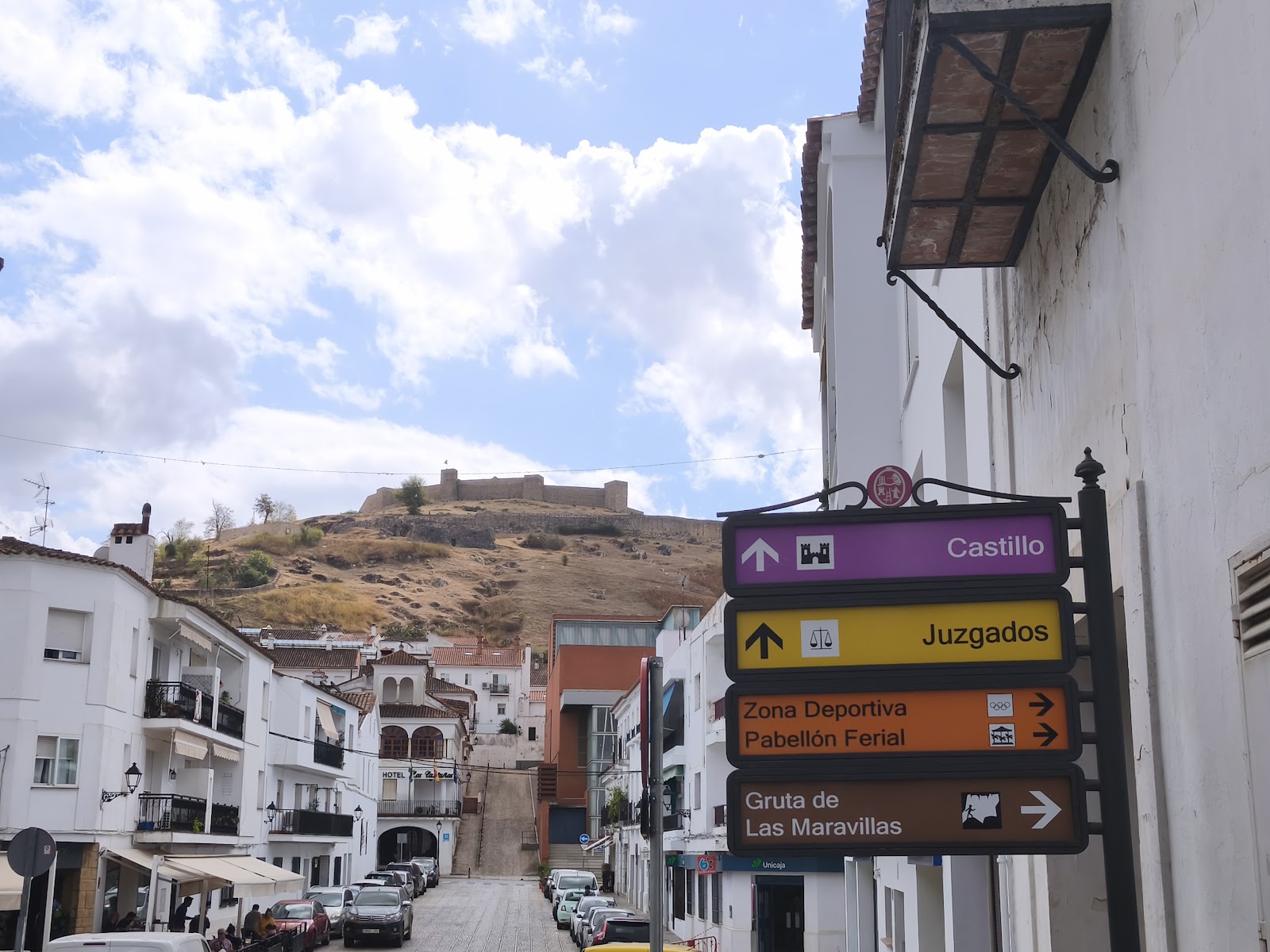
The view from the street terrace places you beneath one of Aracena’s most recognisable landmarks, with the castle rising beyond the road signs.
What Is a Menú del Día?
A menú del día is a fixed-price lunch offered by many Spanish restaurants, most commonly on weekdays. You are usually given several options for a primer plato and a segundo plato, followed by dessert or coffee. A drink is often included, although every restaurant decides its own arrangement.
The first course might be soup, rice, pasta, salad, vegetables or legumes. The second usually moves towards meat, fish, eggs or another substantial dish. This is a useful pattern rather than a rigid rule; the choices in front of you matter more than the category they have been placed beneath.
At Las Tinajas, our menu included a first course, second course, drink, and dessert. Elsewhere, coffee might replace dessert, bread may or may not be included, and certain drinks can carry a supplement. Ask before ordering if the terms are not written clearly.
The format has a history. Spain’s regulated menú turístico appeared in the 1960s as a complete meal offered at a set price. By 1970, official rules were already using the name menú del día. The legal requirement eventually disappeared, but the lunch itself stayed and became part of ordinary restaurant life. Anyone curious about that history can read the original regulations in Spain’s Boletín Oficial del Estado.
Today, its appeal is wonderfully uncomplicated. The kitchen can cook a manageable selection in useful quantities, and the diner receives a complete meal for less than the same number of courses might cost from the main menu.
Our €13 Menú del Día
On our first visit, it was just my partner and me. We chose different dishes at every stage of the menú del día, giving us four plates to pass back and forth across the table.
I started with the salmorejo, served cold and topped with pieces of regional jamón. It suited the warm afternoon perfectly. My partner ordered the beans, which arrived in a portion generous enough to carry the weight of a main course.
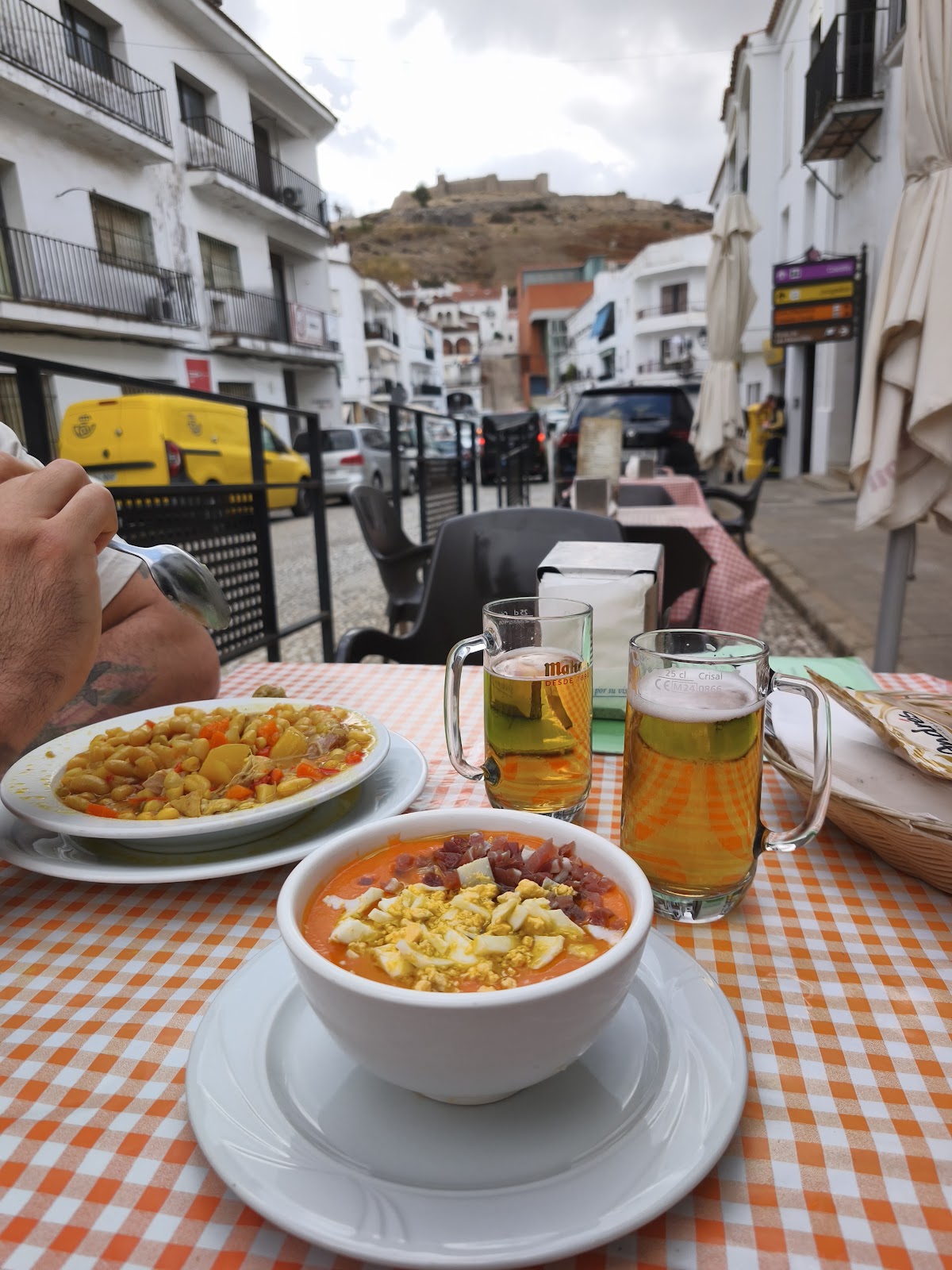
Salmorejo and a generous plate of beans were our two first-course choices from the €13 menú del día.
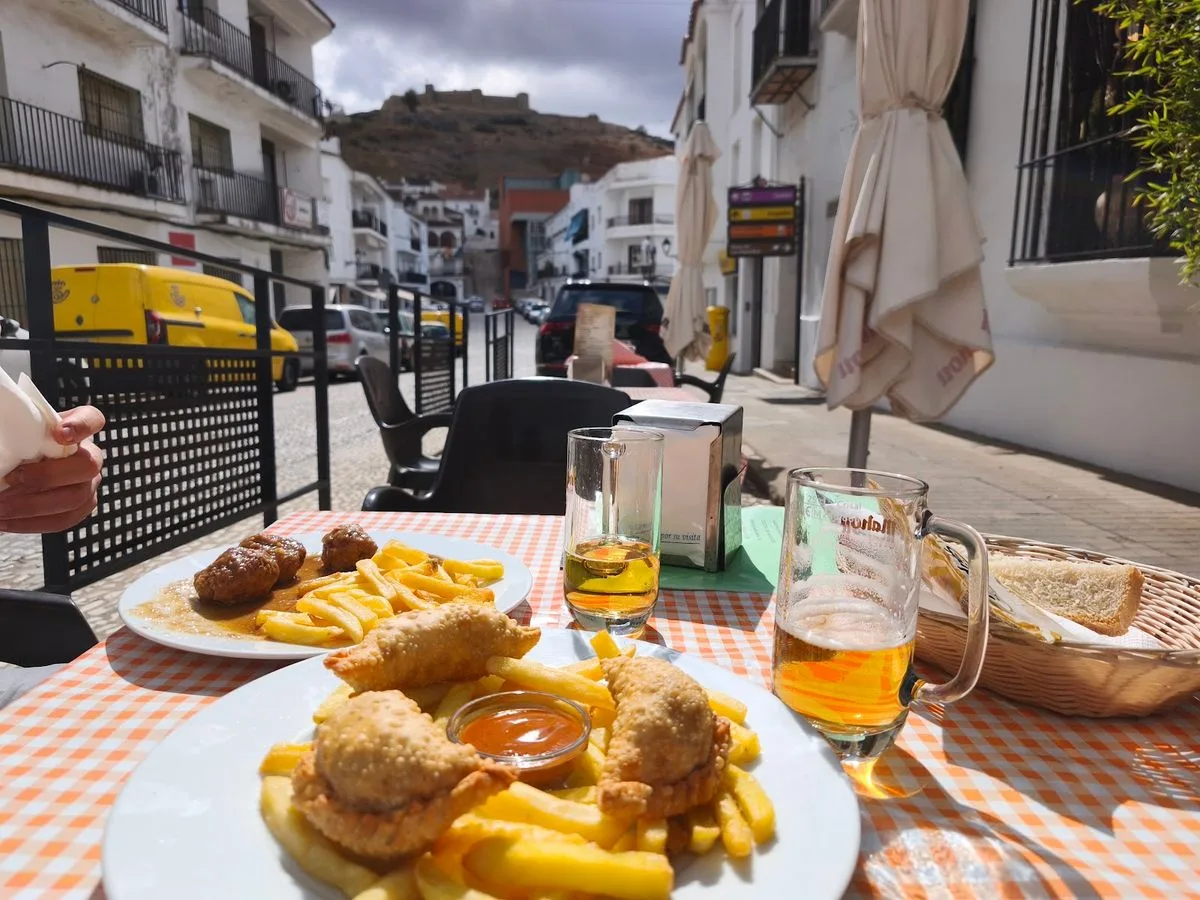
Next came Argentinian empanadas and carrillada ibérica. The empanadas had crisp pastry around a deeply savoury filling. Across the table, the pork cheek was tender from slow cooking and covered in a rich sauce. Bread became essential once most of the meat had disappeared.
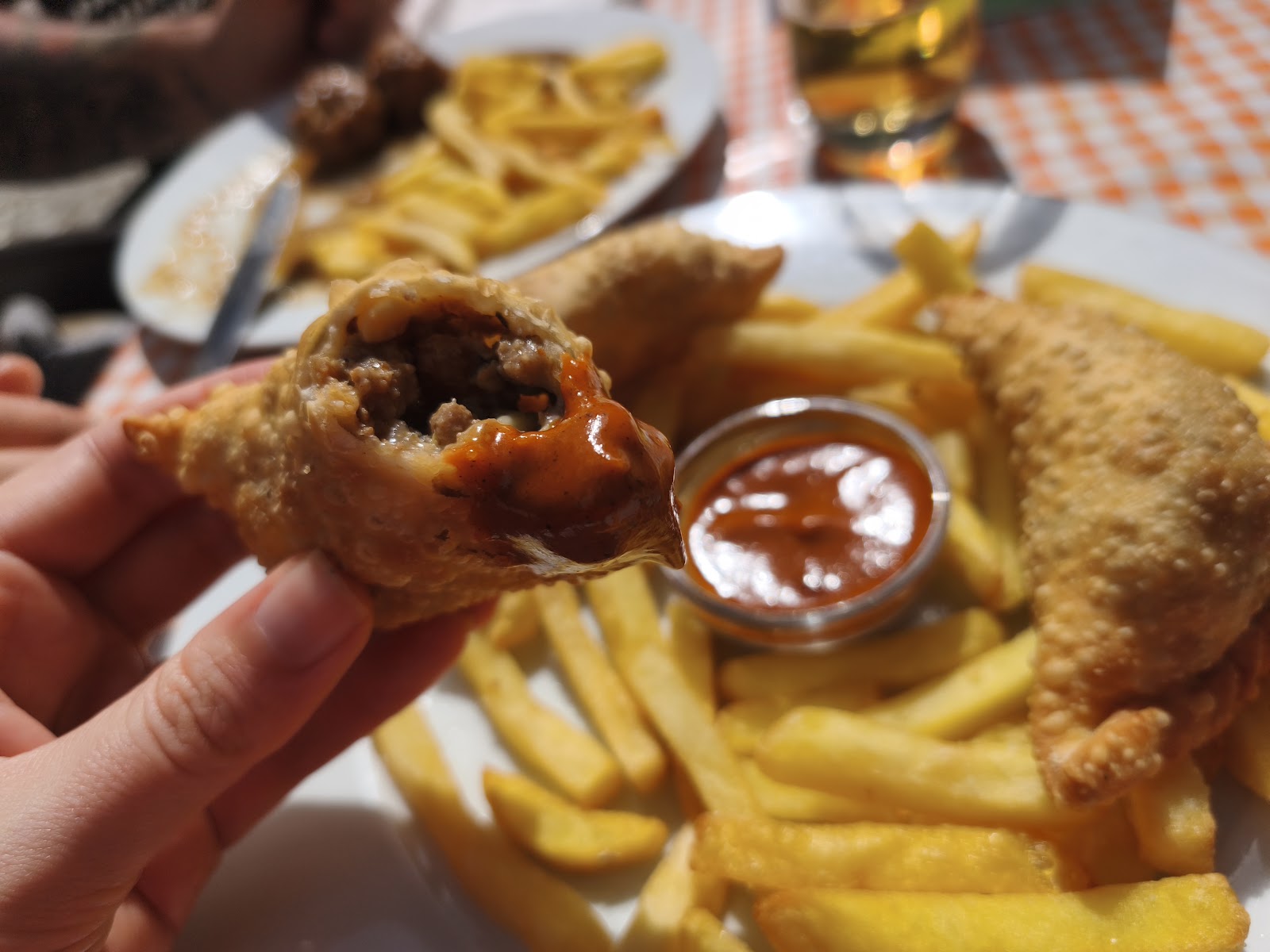
The crisp pastry opened onto a deeply savoury filling, with carrillada completing the second course across the table.
We ordered a beer each, both included in the set price. By dessert, neither of us particularly needed another course, although that did not stop us from choosing tiramisu and cheesecake. We shared bites of both before admitting that the menú del día had thoroughly defeated any chance of leaving hungry.
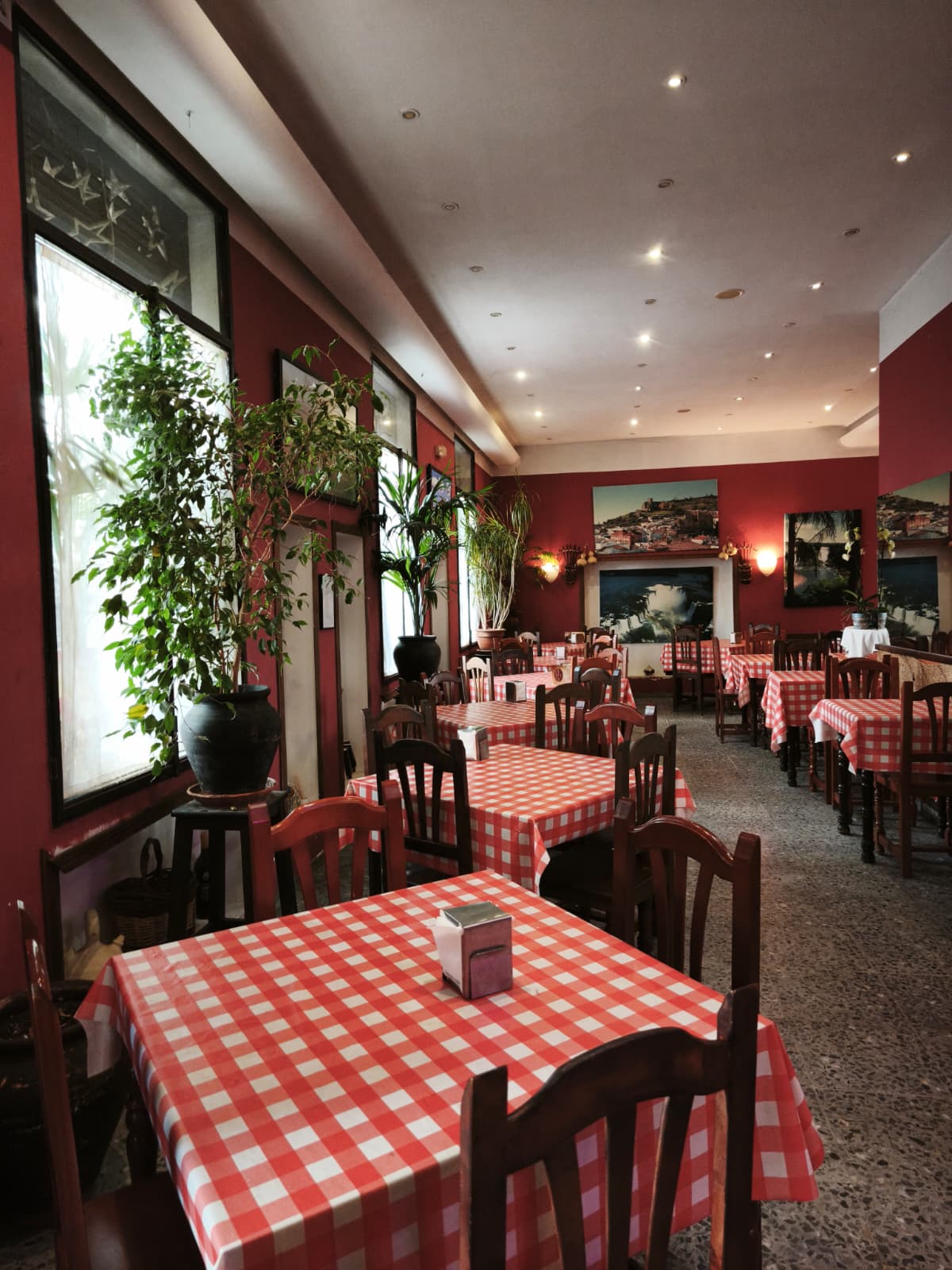
Checked tablecloths, dark wood and photographs of the town give the dining room its traditional character.
The entire lunch cost €13 per person and included a first course, second course, drink and dessert. That was the price during our visit, so confirm the current menu before sitting down with the same figure in mind. Even so, it gives you a clear sense of why the Spanish menú del día remains so appealing: for thirteen euros, we had eaten a complete, generous lunch beneath Aracena Castle.
Service on an Ordinary Afternoon
The service during that first lunch was seamless. Ordering was straightforward and the courses arrived without long waits between them. The meal moved naturally from one plate to the next.
That balance is one of the pleasures of a good menú del día. It is designed to feed people properly in the middle of a working day. Efficiency belongs to the format, but so does the expectation that you will sit down and enjoy the meal placed in front of you.
How to Order Without Getting Lost
The choices may be printed, written on a board or explained aloud at the table.
Choose one dish from each course unless the server explains otherwise. Once you have ordered, the plates generally follow in sequence rather than arriving together.
Lunch is often the main meal of the day in Spain, and the menú del día was created with that appetite in mind. Two courses at midday do not seem excessive when dinner may not begin until nine or ten at night.
Coffee and sobremesa can extend the time at the table before the afternoon resumes. A merienda bridges the later hours if hunger returns before dinner. Our guide to why dinner is so late in southern Spain explains how meals become a main character in the Spanish day.
Vegetarian Options: Ask One More Question
Las Tinajas does offer vegetarian choices. As elsewhere in Spain, however, the name of a dish does not always tell you everything used to prepare it.
A plate described through beans, rice, mushrooms or vegetables may have been cooked with meat stock. Jamón, chorizo or another pork product can appear as seasoning without earning a place in the title. Even salmorejo is commonly served with jamón scattered over the top, although it may be possible to request it without.
The daily selection changes, so the best vegetarian option on one visit may not appear on the next. Ask what the kitchen can offer that day and confirm the ingredients before choosing.
Why We Returned
The first lunch had given us more than a good price. The food was generous, the service was smooth and the location worked beautifully with the rest of our day in Aracena. When we needed a restaurant during the Feria del Jamón, Las Tinajas already had our confidence.
We made the reservation in advance because feria weekends draw thousands of people into town. By lunchtime, restaurants are full, and visitors who arrive without a plan may find themselves walking from one crowded dining room to another. We had spent the morning exploring the producer stands and watching competitions before leaving the fairground for our table near the Museo del Jamón. You can read more about that experience in our first-hand review of the event.
This visit had a different energy from the first. We were with a larger group, so we went into full Spanish lunch mode: tapas began appearing for everyone to try, followed by larger dishes placed at the centre of the table. Once the plates had been cleared, we stayed for coffee and conversation rather than treating that as our cue to leave.
We did not order the menú del día. This was a longer lunch built around sharing and spending the afternoon together.
Our Feria del Jamón Lunch
We returned to salmorejo and carrillada, two dishes we already knew suited the restaurant. For the table, we also ordered two plates of secreto ibérico a la naranja, the pork carrying a distinct orange flavour that lifted the richness of the meat. The meat was cooked perfectly; a knife passed through it with almost no resistance.
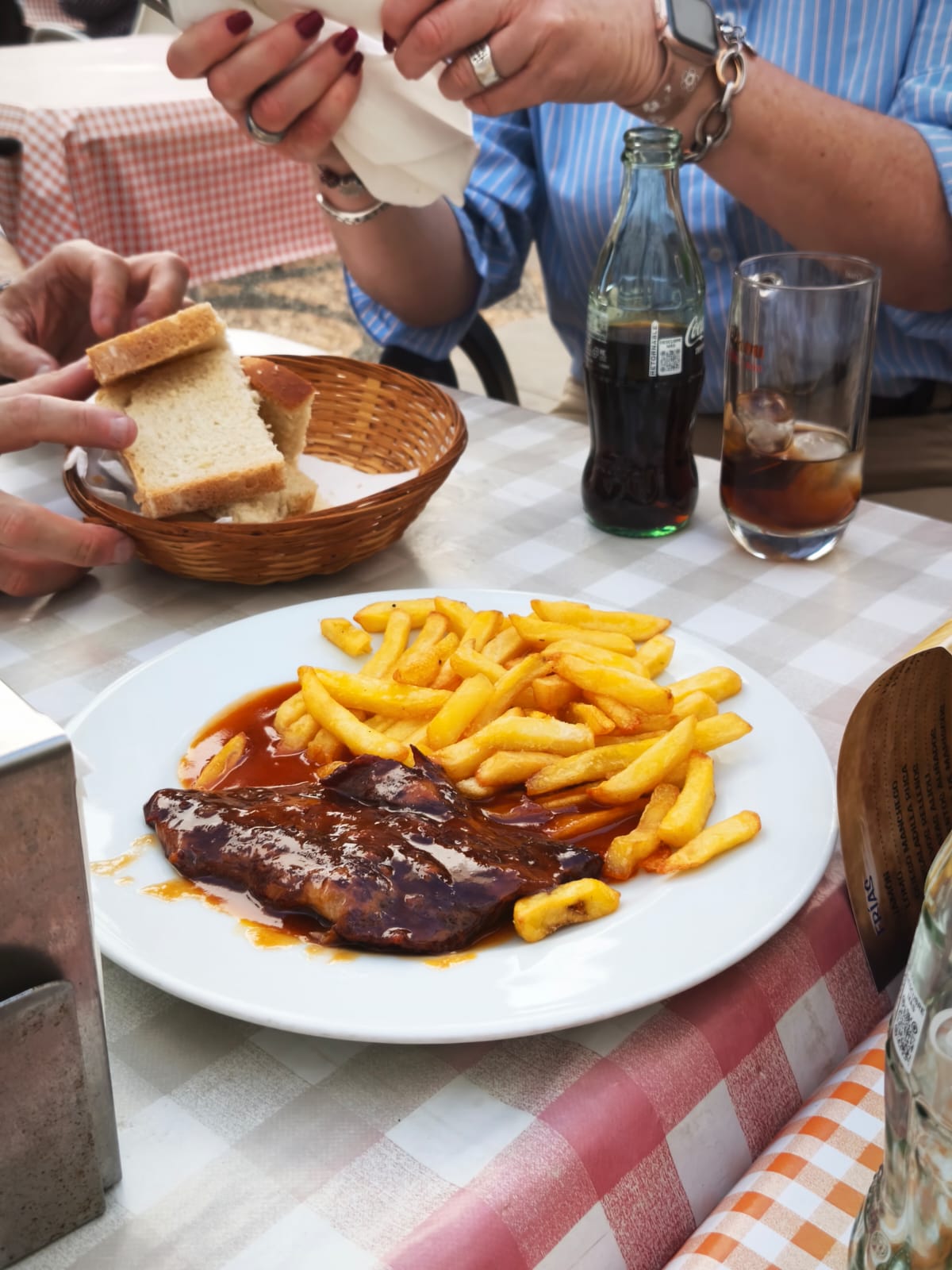
The secreto ibérico a la naranja was one of the highlights of our second lunch, with tender pork and an orange flavour that lifted the richness of the meat.
The largest arrival was a broad pan of rice with mushrooms made for sharing. It occupied the centre of the table and gave the lunch a suitably generous scale. The Sierra’s autumn mushroom season had found its way directly into our feria meal.
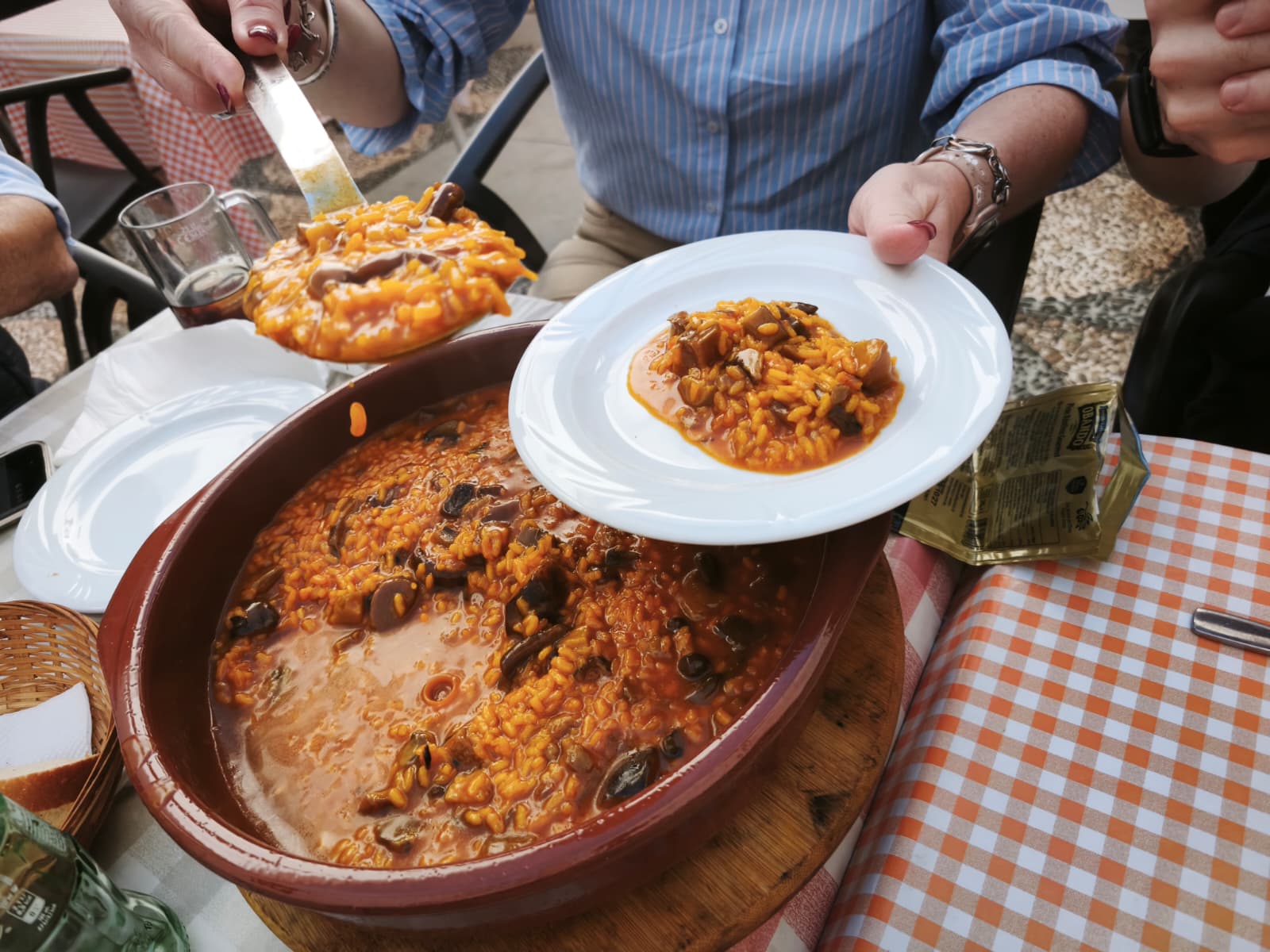
This generous pan of mushroom rice was made for sharing and immediately claimed the centre of the table.
We left extremely happy with the food. That deserves to be stated plainly, particularly because the afternoon did not move at the same speed as our first visit.
Aracena was exceptionally busy for the feria, and Las Tinajas was serving far more people than on an ordinary afternoon. This was not a quick-service lunch, nor should you approach it as one during a major event. Come prepared to spend time at the table.
If you reserve during the Feria del Jamón or another busy weekend, avoid placing a cave booking or other timed activity immediately after lunch. Leave enough room for the meal to run longer than expected. A slower pace feels far less frustrating when you have planned for it, and Spanish lunch culture provides no reason to treat a long meal as time lost.
There were five of us at the table. Our order included:
Salmorejo
Carrillada
Two plates of secreto ibérico a la naranja
A large pan of rice with mushrooms
One drink per person
Coffee for everyone after the meal
The final bill was €75 in total, or €15 per person.
That price surprised us almost as much as the €13 menú del día had during our first visit. Las Tinajas fed five people generously during one of Aracena’s busiest weekends, and the quality never felt compromised by the affordability. Prices will change, of course, but our two meals tell a consistent story: this restaurant offers remarkable value for the amount and quality of food placed on the table.
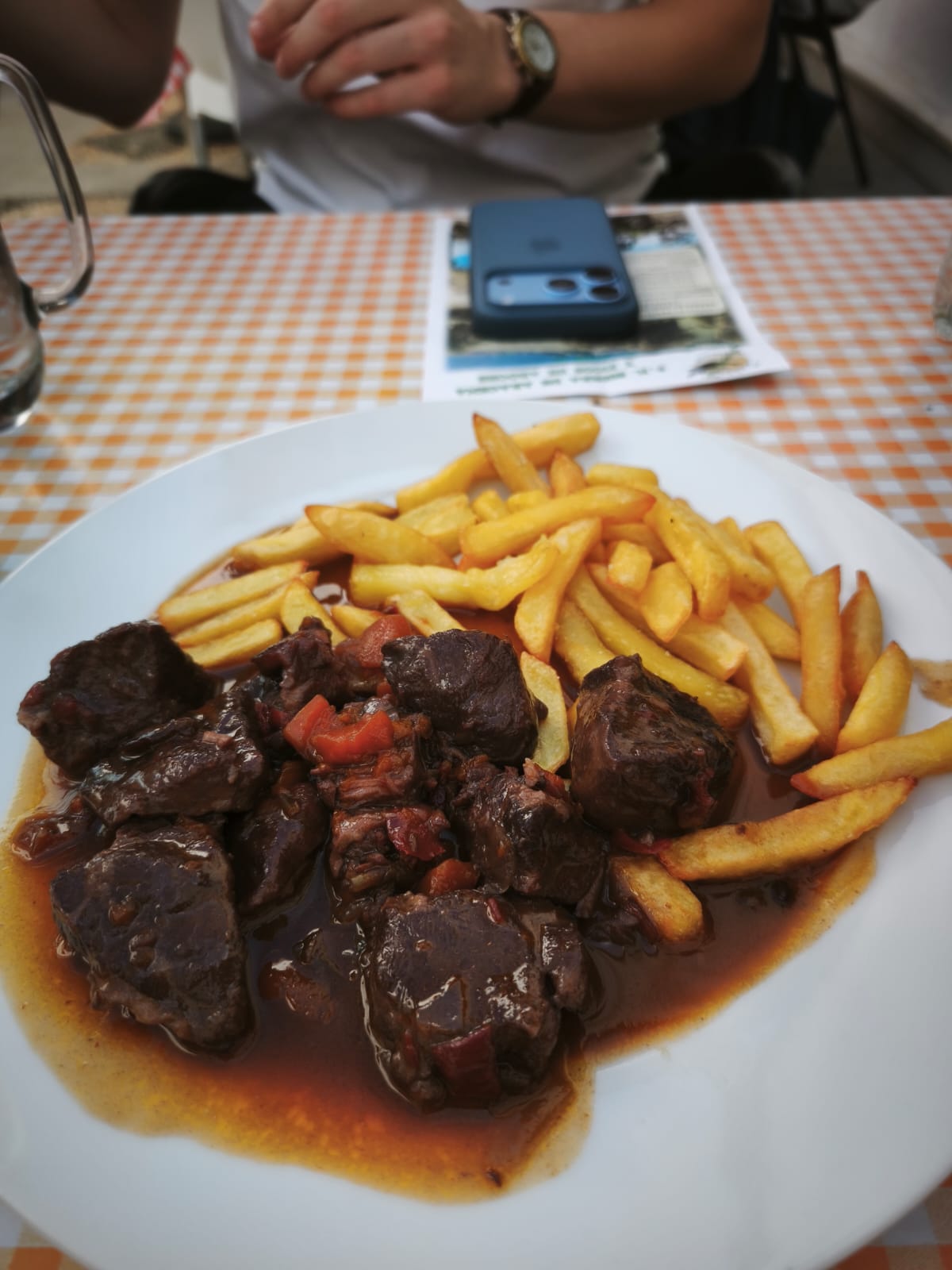
We returned to the carrillada during our feria lunch after enjoying it so much on our first visit.
The Sierra on the Plate
Our two meals moved through several ingredients closely associated with the region. Jamón appeared over the salmorejo, and ibérico pork returned through the carrillada and secreto. These are not token additions designed to make a menu appear local. The pig, the dehesa and the curing industry support livelihoods across the Sierra.
Our guide to jamón ibérico in Aracena explains the coloured seals, the montanera and the woodland behind the product. The Museo del Jamón next door approaches the same subject through seven exhibition rooms covering the animal, its diet and the curing process.
Mushrooms take us to a different part of the landscape. Autumn rain brings fungal life back to the woodland, and local kitchens respond when the season is generous. Our October mushroom guide explores that relationship in greater depth. At Las Tinajas, we encountered it in the most persuasive form possible: a spoonful of mushroom rice passed across a crowded table.
Building Lunch into Your Aracena Day
Las Tinajas is easy to include in a day around the lower part of the castle hill. Book the Gruta de las Maravillas for the morning and visit the Museo del Jamón before lunch. The restaurant is next door, so you can move between all three without returning to the car.
If your visit coincides with the Feria del Jamón or another busy event, leave plenty of room around the reservation. A higher volume of diners can slow the service, and placing a timed ticket immediately after lunch may leave you watching the clock instead of enjoying the meal.
What happens next depends entirely on how your body responds to a generous lunch. Some of us want to get moving again; others enter an immediate and unavoidable food coma.
For the food-coma crowd, Aracena’s tourist train offers a family-friendly alternative to walking uphill. It leaves from Plaza de San Pedro beside the Gruta, travels through town and climbs towards the castle hill, where it makes a short stop. The train operates mainly on weekends and public holidays, and departures depend on reaching a minimum number of passengers. Check the current schedule before planning around it.
If movement is exactly what you need after lunch, follow our walking route from Aracena’s market to the castle. The route takes you through the town before beginning the climb, giving your legs a little time to prepare.
Try to reach the castle hill as the afternoon begins moving towards sunset. The light across Aracena softens beautifully at that hour, and the rooftops below take on a warm glow before evening settles over the Sierra.
Practical Information
Name: Las Tinajas Bar Restaurante
Address: Calle Juan del Cid López, s/n, 21200 Aracena, Huelva
Location: Beside the Museo del Jamón; open Las Tinajas in Google Maps
Telephone: +34 959 12 61 06
Reservations: Call ahead for weekends, holidays and local events
Frequently Asked Questions
Is Las Tinajas attached to the Museo del Jamón?
The restaurant occupies the same building complex and sits immediately beside the museum. The museum describes the restaurant as privately managed, so treat them as separate businesses when checking tickets, opening hours or reservations.
Is the €13 menú del día still available?
That was the price during our first visit. Set menus and prices can change, so ask what is being offered when you arrive.
Does Las Tinajas have vegetarian options?
Yes, vegetarian choices are available. Confirm the full ingredients before ordering, especially in soups, beans, rice dishes, sauces, and vegetable preparations that may contain meat stock or small amounts of pork.
Should I reserve?
We would reserve for weekends and holidays. During the Feria del Jamón or another major event, consider it essential.
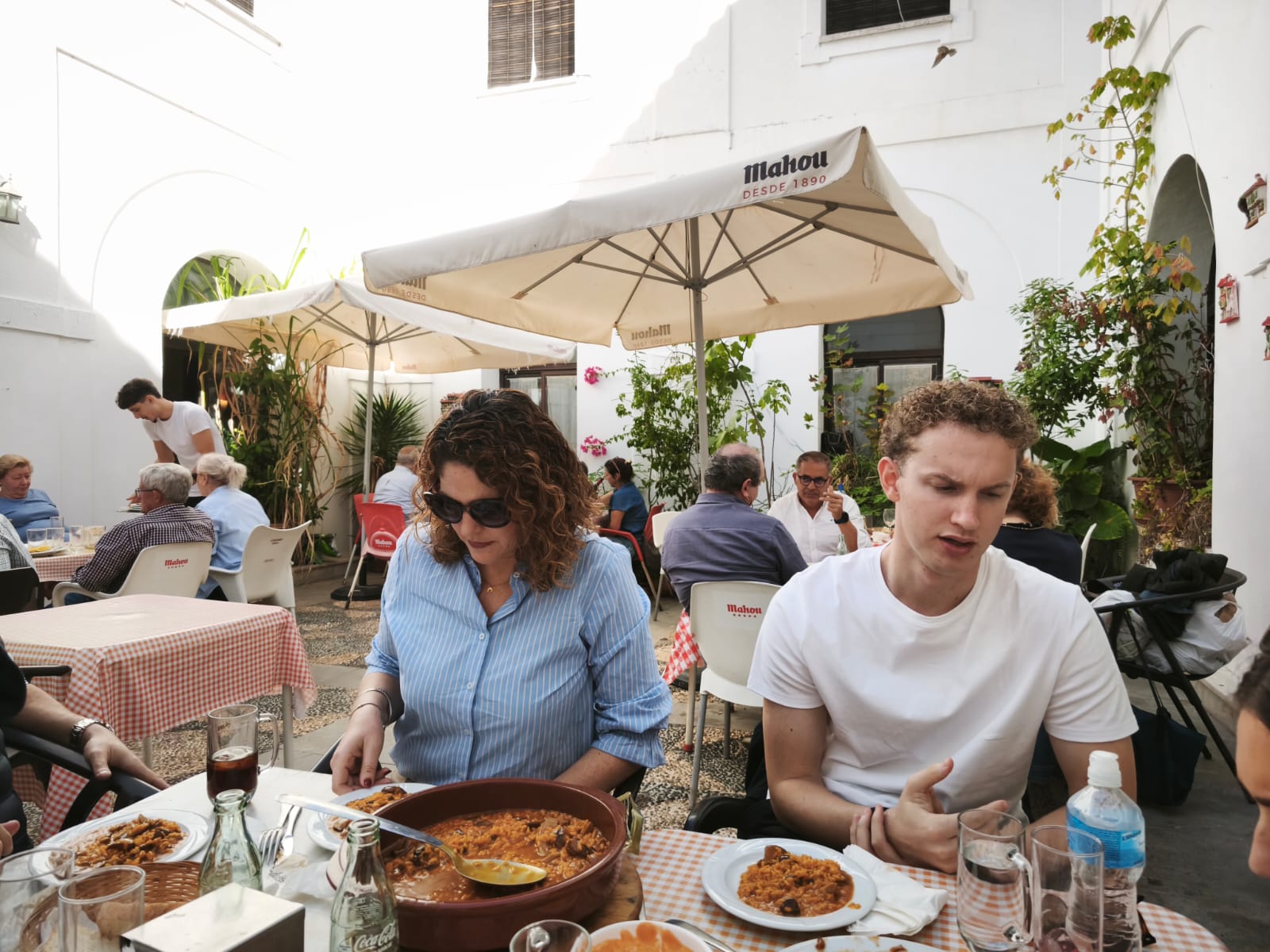
Our second visit unfolded over shared plates, mushroom rice and coffee on a patio filled with other feria-weekend diners.
Would We Return?
We already did.
Our first visit gave us a generous €13 menú del día, served with the ease of an ordinary afternoon. The second brought a pan of mushroom rice to the centre of our table during Aracena’s busiest food festival. Service took longer that day, as we expected it would, but the food gave us every reason to remain in our seats.
Las Tinajas works because it can belong to more than one kind of Aracena day. You can come for an affordable set lunch after the museum or reserve a table for a larger gathering. Either way, arrive hungry. Your taste buds (and your stomach) will be very glad you did.